I grew up with this soap in Ethiopia. What is sold here under the same name is not the same thing.
My name is Hanan Yusuf and I make Nilah. Before you buy another black seed bar, from us or from anybody else, I want to show you what I check, starting with the two words “Made in” on the back of the box, and why so little of what reaches an American bathroom is the bar I grew up with in my grandmother's.

A few years ago I flew home to Harar to see my grandmother, and within about a day of being back in the house she noticed it.
Not the other way around. She noticed me. I was thirty-six, and I had been hiding the skin under my arms and under my breasts since I was twenty-two. Bumps that came up sore and hot about a week before my period, went down, and came back. Raw, red skin along my bra line. A smell by mid-afternoon that no amount of showering explained.
I was good at hiding it. Sleeves in every season. A spare top in my bag. Two showers a day, sometimes three, with the strongest wash I could find and the roughest cloth I owned.
Fourteen years, and I had not said one word about it to anyone in my family.
On the second afternoon she asked me to reach the coffee tray down from the high shelf. I used my left arm, because that week I could not lift my right one without wincing. She watched me do it. She said nothing. Not yet.
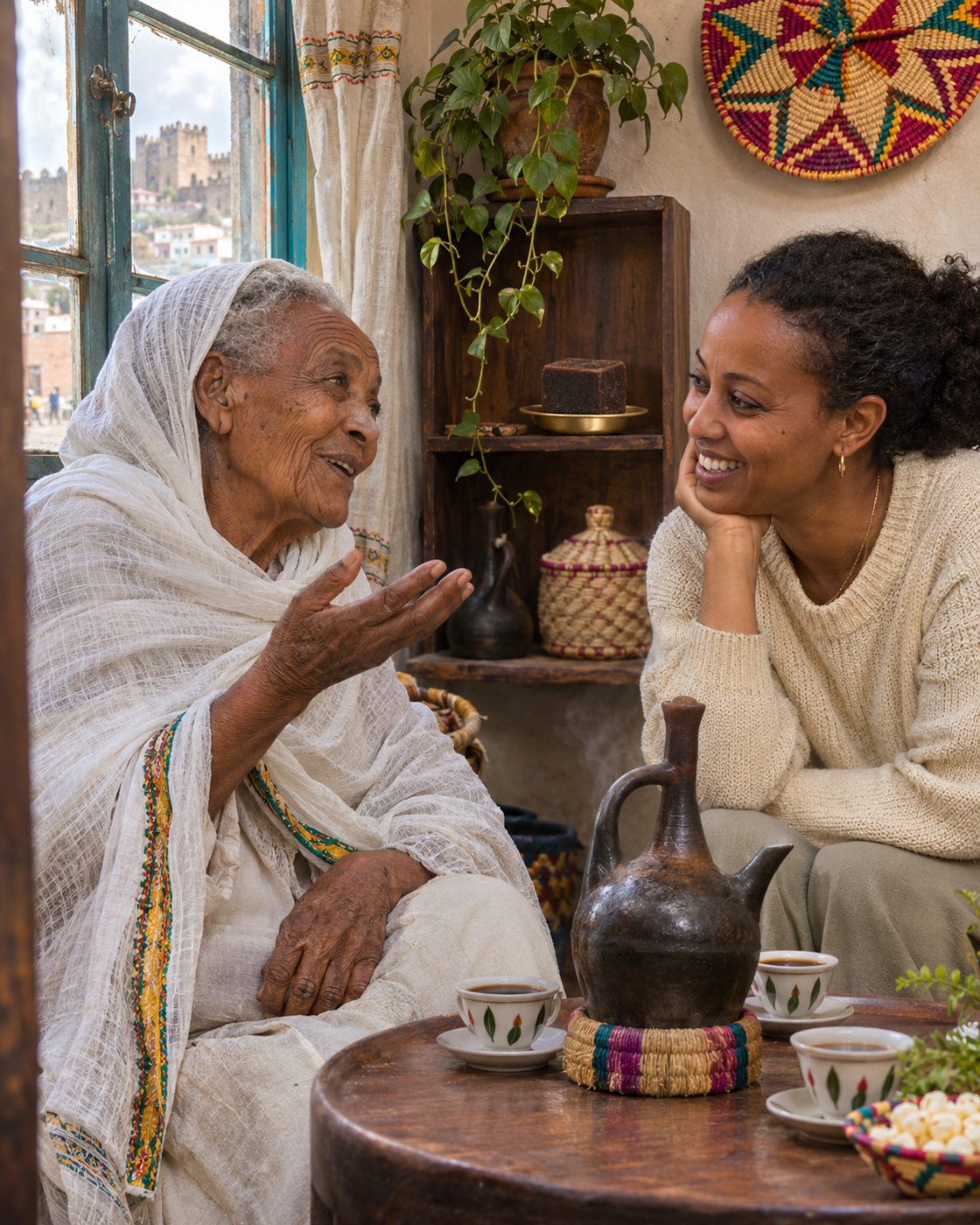
My grandmother was the one who said it out loud
She was eighty-four then, and she belongs to the generation that simply says things. That evening, while the coffee was roasting, she put down the pan and said: “Show me your arm.”
I showed her. I was thirty-six years old and I felt about nine.
She was not remotely surprised. She did not make the face I had spent fourteen years bracing for. She looked at it the way you would look at a scraped knee, and then she told me I was washing my skin like a floor. Too hot, too hard, too often. “You are not dirty,” she said. “You are fighting your own skin.”
Then she got up, went into her washroom, and came back with a bar of soap.
“Wash with it, and leave the foam a minute,” she said. “Do not scrub. Then leave it alone.”
And I stood there holding it and understood that I had been looking at that soap my entire childhood.
It had been sitting on that shelf for as long as I could remember.
Brown, plain, a little rough at the edges, not the sort of thing you would ever pick up and examine. I must have walked past it ten thousand times as a child. I had never once wondered what it was for.
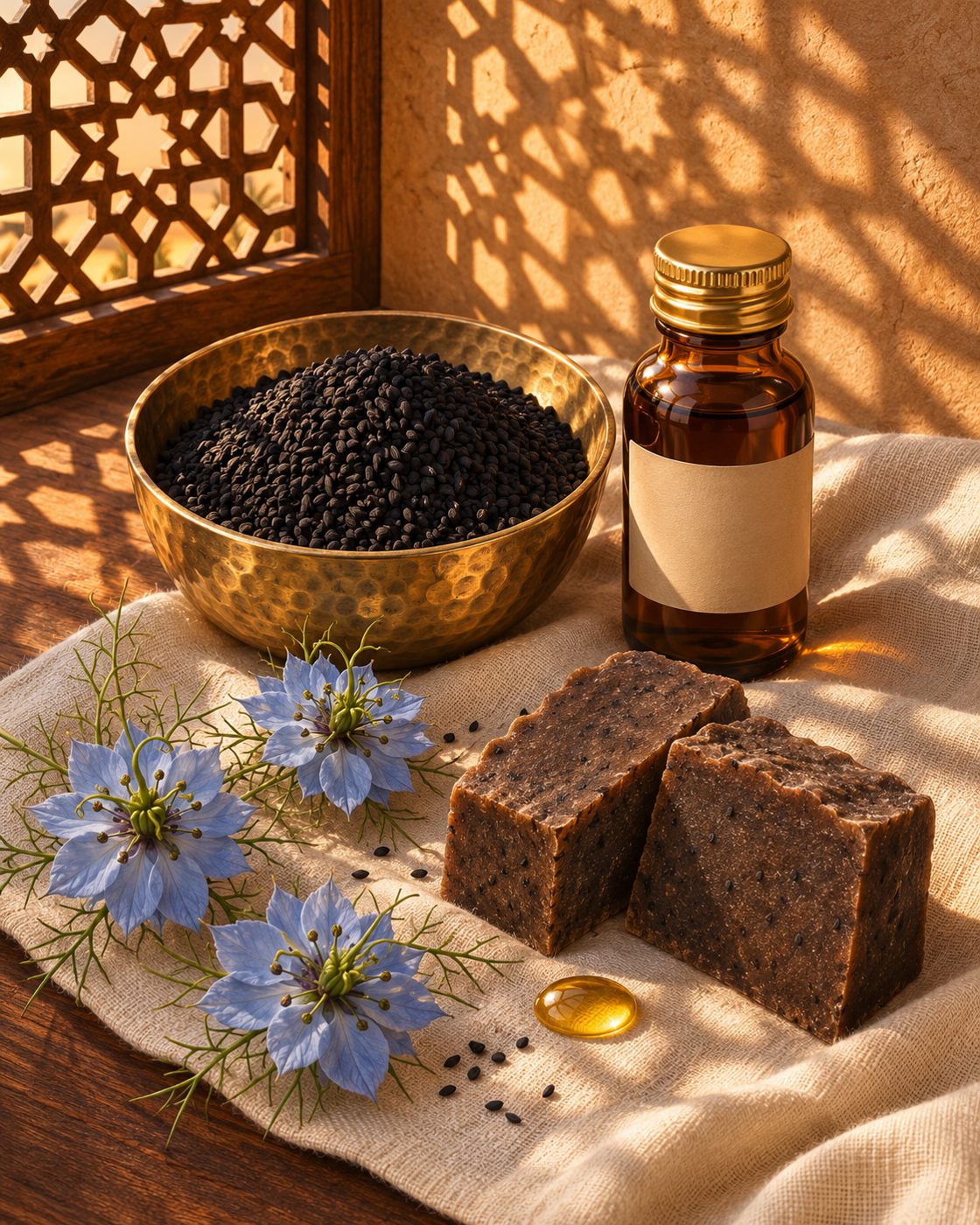
It is made with black seed oil. Nigella sativa. In Amharic the seed is called tikur azmud. In Harar, an old walled city where Arabic has been spoken alongside everything else for a thousand years, people just as often say habbat al-baraka, the seed of blessing. The seeds are pressed cold, slowly, until they give up a dark, peppery, slightly bitter oil, and that oil goes into the family soap. In my grandmother's house it is completely ordinary: it is in the kitchen, in the medicine tin and in the washroom, and nobody there would call it a product. Nobody had ever explained it to me because to my grandmother there was nothing to explain.
I did exactly what she told me. Twice a day. Foam on, count to sixty, rinse, pat dry. No cloth. No scrubbing.
By the end of that visit the skin under my arms felt calmer than it had in years. Less heat. Less of that tight, sanded feeling. The smell I used to check for at three in the afternoon was not there to check. The next month, the week I always dreaded came and went, and I only realized it afterwards.
I flew back to Minneapolis with four bars in my suitcase. I have washed with it every day since.
Then a friend told me about her own skin
My parents brought me to the United States when I was nine, so by then my friends here were women I had known for most of my life. A few months after that trip, one of them brought it up with me, awkwardly, half apologizing, the way you do when you are saying something you have never said out loud. Under her breasts. Every summer, and every month before her period. She showered twice a day and still checked herself in the bathroom at work.
I recognized exactly where she was standing, because I had been standing there myself for fourteen years.
I still had two bars left. I gave her one and repeated what my grandmother told me, word for word. Wash with it. Leave the foam a minute. Do not scrub.
It worked for her too. She told somebody. Soon I was being asked for it by women I had never met, and when I went looking to buy more of it here, I found out two things.
The first is how many women are living with this and have never said it to anyone. Not their mother, not their partner, sometimes not even their doctor. Most had decided it was a hygiene failure, and were showering twice and three times a day, scrubbing harder and harder at the one kind of skin that cannot take it.
The second is that the bar I wanted to hand them is not sold here. Not really. I ordered every black seed soap I could find online. Some were jet black and smelled like a scented candle. One left a gray ring on my sink. None of them did a thing for my skin. So I turned the boxes over. Not one of them was made in Ethiopia, and most were made a very long way from anywhere the seed grows. There is no standard behind those two words: a bar built on real cold-pressed oil and a bar built on charcoal, fragrance and one drop of oil for the label can print “black seed” in the same size type on the front of the box, and both are perfectly legal.
Which is why I ended up making it myself
And when a cheap bar does nothing, you do not conclude that the bar was cheap. You conclude that black seed soap does not work.
That is the part that bothers me. Not the lost sales: we are small and new and I am not owed anybody's money. It is the women who tried this, got a perfumed black bar, felt nothing after a month, and quietly gave up on the one thing that was going to help. The way I would have, if my grandmother had handed me the wrong one.
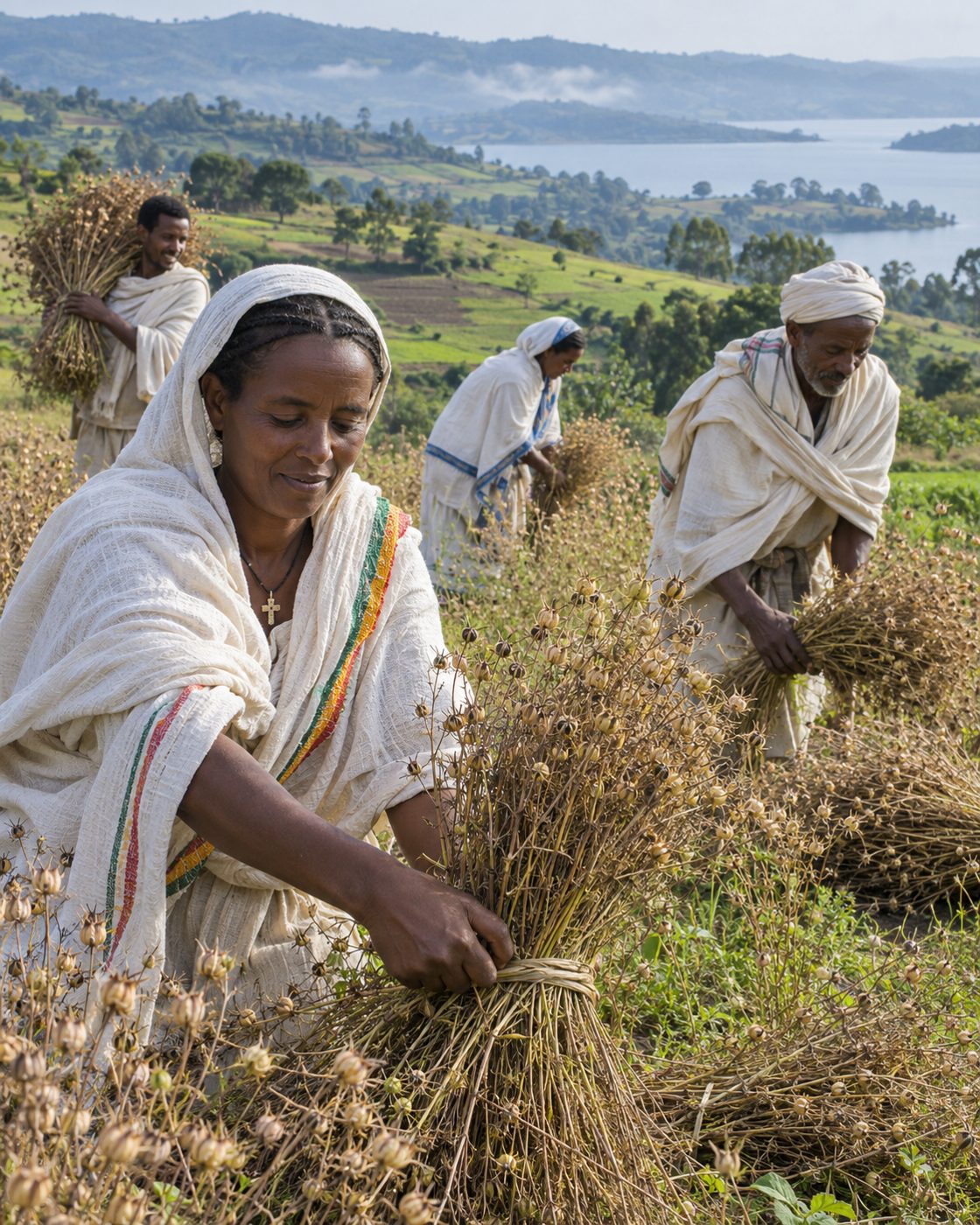
So I stopped trying to find it and had it made properly, by hand, in Ethiopia, where the seed grows. Nilah is handmade there with ancestral, artisanal know-how, around the same oil my grandmother's bar is built around: certified organic black seed, grown in Ethiopia and cold-pressed the traditional Ethiopian way, never heated, never stretched with something cheaper. It is the oil at the level it is actually meant to be, rather than a trace of it dropped in so that the word can go on the front of a box.
It is made in small batches, because it has to be. Black seed is harvested once a year, when the rains end, and there is only ever as much oil as that harvest gives. We make what it allows and then we stop. That is also why we run out sometimes, and I would rather say so plainly than pretend we have an endless supply of something that takes a year and a harvest to produce.
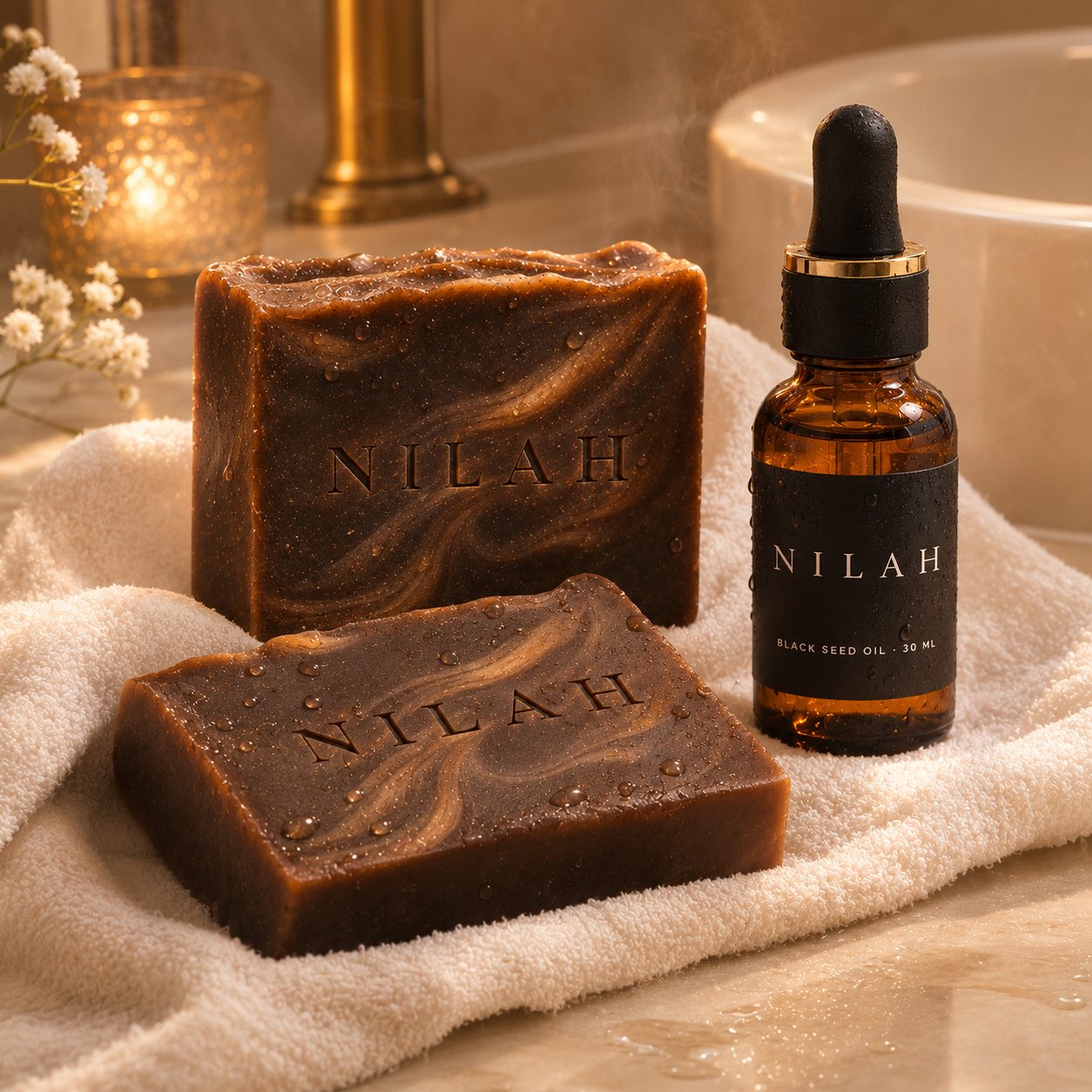
A full 120g bar of black seed oil soap, handmade in Ethiopia by the traditional Ethiopian method. Naturally brown. No charcoal, no dye. Nothing attached to the checkout.
See Nilah: current bundle pricingSold only at nilahskin.com100% money back within 30 days. No forms, no return shipping, and you do not have to send the bar back.
- ✓ Certified organic Ethiopian black seed oil
- ✓ 120g bar, handmade in Ethiopia
- ✓ No auto-enrollment
- ✓ One harvest a year
But do not take my word for any of it
I would rather hand you the tests than ask you to trust a stranger on the internet, so here are the six things I check. Most take under a minute. The first one takes ten seconds: you turn the bar over and read where it was made. Run them on our bar as happily as on anyone else's. That is genuinely the point.
- Where it was made, and who sold it to you
- Whether black seed oil is really on the label, and how much of it there is
- What the bar smells like
- What it does to a white cloth
- What it weighs
- Whether the price is arithmetically possible
Turn it over. Where was it made?
This is the ten-second one, and it settles more cases than the other five combined.
Turn your black seed soap over and find the words “Made in”. Black seed soap is an Ethiopian family soap, and Ethiopia is one of the countries where the seed is grown and pressed. A real one is made where the seed grows. If your box names a country with no black seed fields at all, or names no country, you are holding a soap that borrowed the name. Nilah is handmade in Ethiopia, with ancestral, artisanal know-how and Ethiopian black seed oil, and the box says so.
It is also sold in exactly one place: our own store. We have no marketplace listings, no resellers, no third-party sellers and no wholesale accounts. If your bar arrived from a marketplace, an auction site or any storefront that is not ours, it is not our soap, however closely the box resembles it.
You do not need to unwrap anything for either one. Read the back of the box, then open your order confirmation and read the seller line, not the product title. The title is the easiest thing in the world to copy.
See the real one →
Sold only at nilahskin.com
Read the label, then ask how much
Everything that matters is printed in the smallest type on the box.
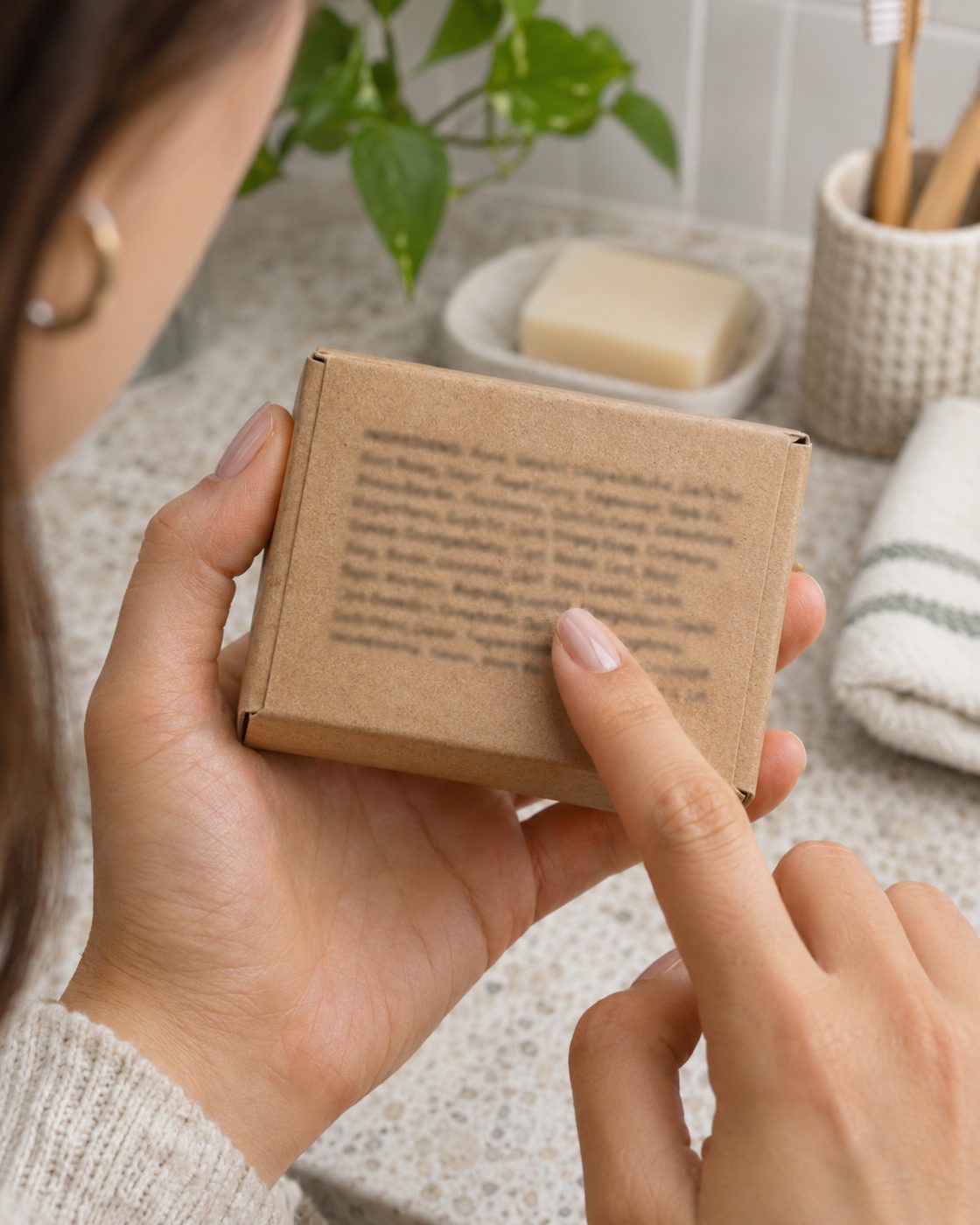
The box is already turned over, so now find the ingredient list. You are looking for three words: Nigella Sativa Seed Oil. If black seed appears only on the front of the box, or does not appear in the list at all, or there is no ingredient list to read: you have your answer, and you can stop.
But if it is there, you are only halfway. Because the second question is the one almost nobody asks.
How much of it is in there?
Here is a trick the label gives you for free. Under US cosmetic labeling rules, ingredients are listed from the most to the least, down to 1%. Anything at 1% or below can follow in any order. So look for the word “Fragrance” or “Parfum”, which is almost never more than a percent or two of a bar. If Nigella Sativa Seed Oil comes after it, you are very probably holding a bar with 1% black seed oil or less.
Real cold-pressed black seed oil is expensive. The seed is harvested once a year, and it takes a great deal of seed to press very little oil. That cost lands on whoever makes the soap, so the obvious move, and an extremely common one, is to put a token amount of real oil into the bar, name it truthfully on the label, and let the front of the box do the rest of the work. Everything on the box is accurate. The bar still does nothing.
The label tells you whether it is present. It does not tell you how much. So ask. Any brand carrying a real amount will tell you the percentage and show you the certificates without hesitating, because that oil is the most expensive thing they own. The ones that change the subject have answered you.
Ours is certified organic Ethiopian black seed oil at 10%+ of the oils in the bar, and Nigella Sativa Seed Oil sits near the top of our list, far above anything that is only there for scent. The organic certificate and the certificate of origin come with every lot, and you can email us and ask to see them. The thymoquinone analysis for this year's lot is at the lab now, and I will put the number on this page the day it comes back. The full ingredient list is printed on every box.
Smell it
This is my favorite one, because it takes about four seconds and you cannot argue with your own nose.
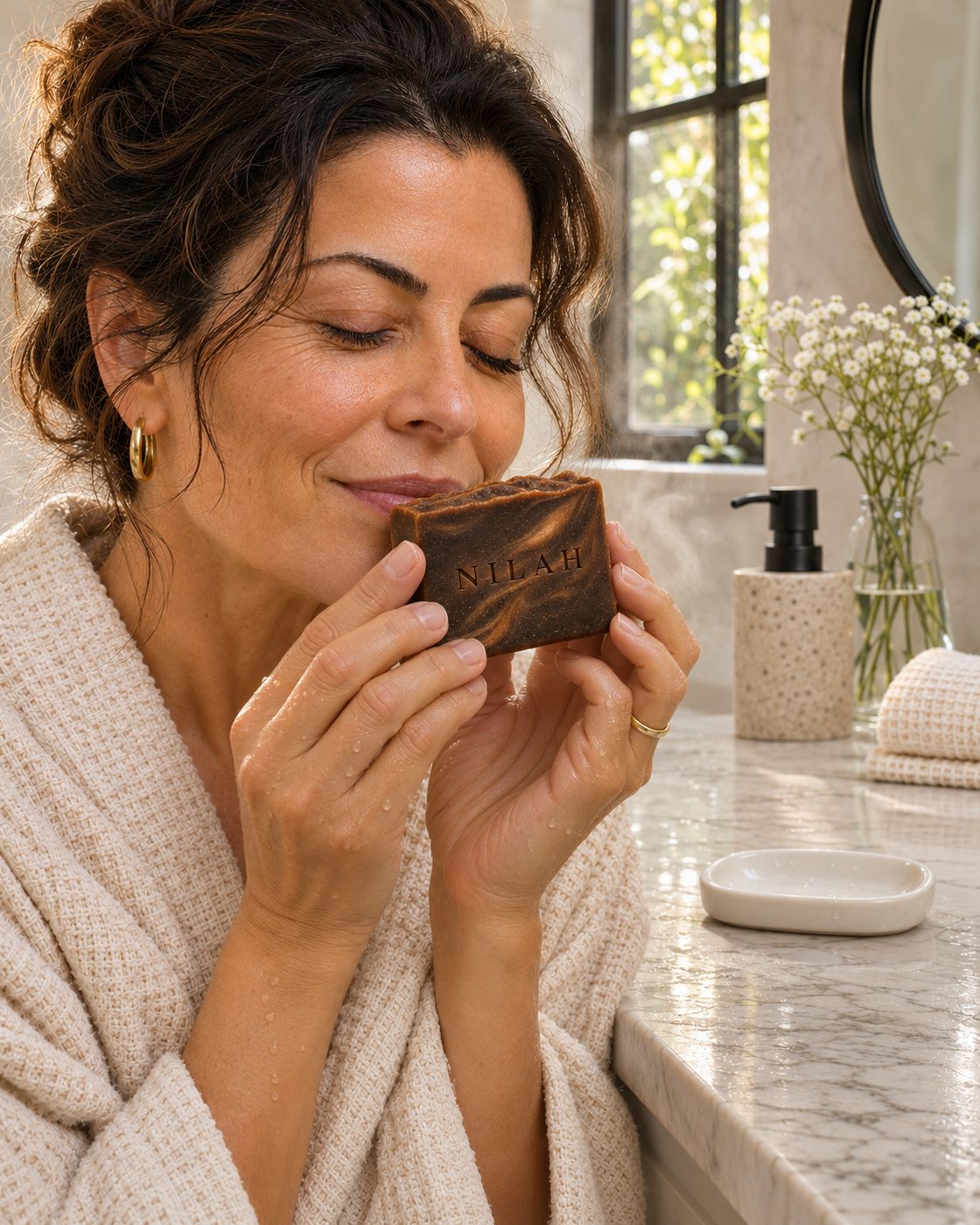
Take the bar out of the box, hold it close, and breathe in.
Real cold-pressed black seed oil has a smell you do not forget. Peppery. A little bitter. Herbal, almost like oregano and cracked pepper in a warm pan. That smell is the thymoquinone, the compound the seed is known for, and it does not disappear when the oil goes into soap. It softens, and it rinses off your skin with the foam, but in the bar it is still there underneath everything else.
A cheap bar smells like a spa. Sweet, powdery, vanilla, “oud”, “amber”, whatever sells that month. There is nothing wrong with liking a nice smell. But if perfume is the only thing you can find in that bar, it is because perfume is the main thing that was put into it.
Do not judge whether you like the smell, by the way. Judge whether the seed is in it. Ours is not a strong bar. It is warm and faintly peppery, and my grandmother's washroom smells exactly like it.
Wet it and rub it on a white cloth
Whatever makes a bar black has to go somewhere. Usually the washcloth first, then the dish, then the towels.
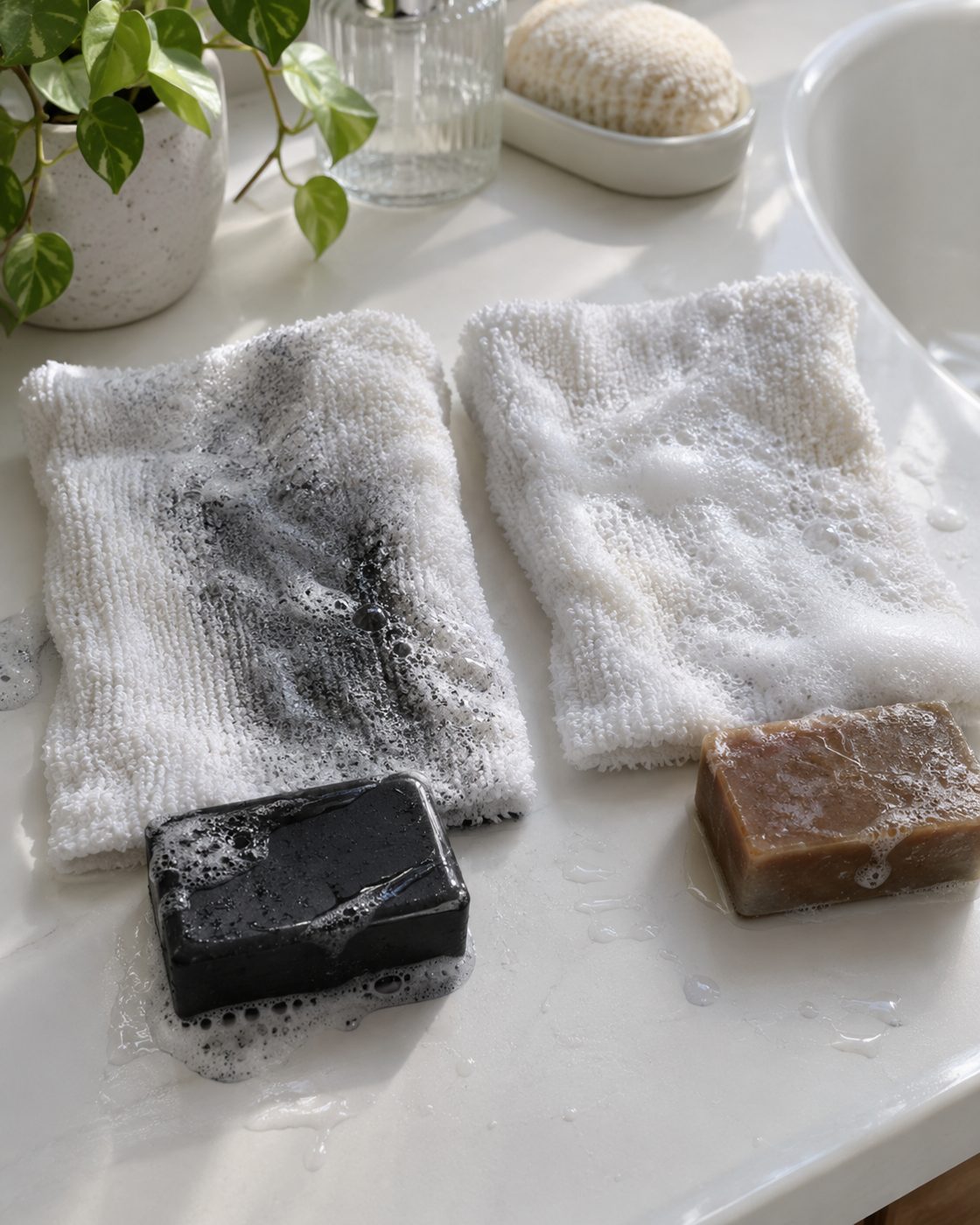
Run the bar under the faucet and rub it a few times on a white cloth or an old white washcloth.
If a gray or black streak comes off, that is activated charcoal or an added colorant, and it is where the black in that bar comes from. Not from the seed. People see a black bar and assume it must be full of black seed. But black seed oil is not black. It is a dark amber-brown, and a soap made with a real amount of it comes out brown, like the one on my grandmother's shelf.
The makers know what you expect a black seed soap to look like, so they give you the color. Charcoal is cheap. It is also gritty, and it is one more thing sitting against the thinnest, warmest skin you have: under your arms, under your breasts, along the tops of your thighs.
Our bar is naturally brown. No charcoal, no dye. Rub it on a white cloth and all you should see is foam.
Put it on the kitchen scale
Thirty seconds, and it changes what you thought you paid.
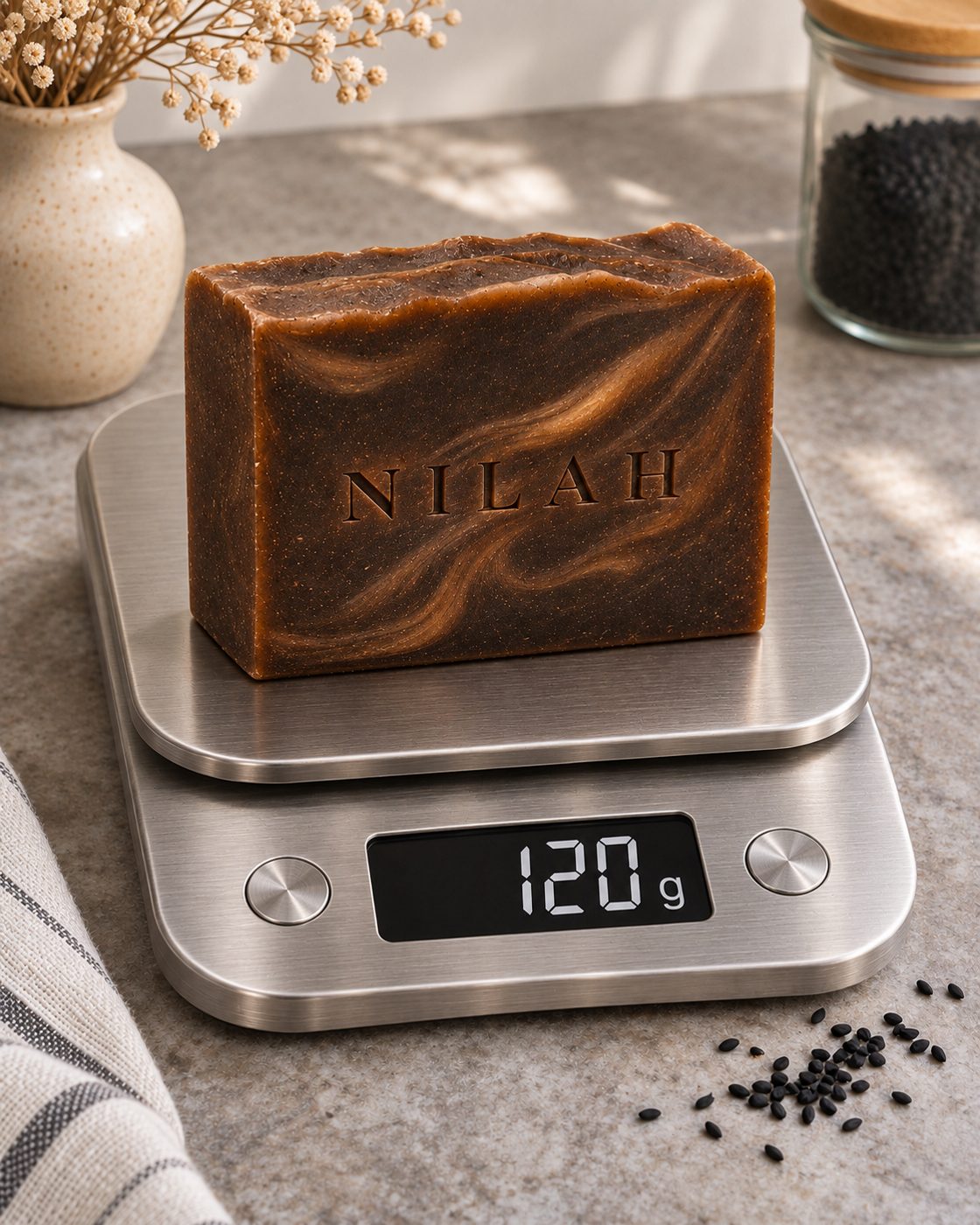
Nobody thinks to do this, and it quietly decides whether you got value.
Online listings advertise the number of bars. They are much quieter about the size of them. A great many of these bars come in well under what you would assume, which is how a “three-pack” ends up costing more per wash than a single full-size bar. It is also why so many reviews say the bar was half gone after a week.
Nilah is a 120g bar, which is what you are looking at above. Weigh whatever you have against that. If yours is meaningfully lighter, work out what you actually paid per gram rather than per bar, and the bargain usually disappears.
Do the arithmetic on the price
This one needs no bar at all, only a minute of thinking.
I have stood beside the press this oil comes out of. Black seed is harvested once a year. It takes roughly seven to nine pounds of seed to press a single quart of oil, cold and slow, with no heat and no solvent to squeeze out more. That is not a marketing flourish, it is simply how this oil has been made for centuries. What comes out the other end is not a cheap ingredient, the certified organic kind least of all, and there is only ever so much of it in a given year.
Now look at two bars for ten dollars, made a continent away from the nearest black seed field, in stock all year round, in unlimited quantity.
Something in that sentence has to give, and it is always the oil. It gets replaced with a cheap base oil, a spoonful of charcoal for the color and a fragrance that smells the way people expect something from far away to smell. The bar then costs almost nothing to make, which is the entire point of it.
What a cheap bar actually costs you
Not the ten dollars. I do not care about the ten dollars and neither should you.
What it costs you is three months and the belief that anything works.
You buy the bar. You use it faithfully. Nothing changes, because a drop of oil under a cloud of perfume was never going to change anything. And somewhere around your second cycle you stop, and you file black seed soap under the long list of things that did not work for you, next to the surgical wash and the powders and the sixty-dollar cream and everything else you have already tried.
Then you go back to scrubbing. Back to the sleeves in July, the spare top in your bag, and keeping your arms down in every photo.
That is the real damage, and it is why I would genuinely rather you ran these six checks on somebody else's bar and found that it passed, than have you write the whole idea off because of something that was never really black seed soap in the first place.
Why we only sell in one place
People ask why we are not on the marketplaces, given that is where the searches are. This is why. The moment a product like this is listed beside forty near-identical black bars, the only thing anybody can compare is price, and we would lose that fight on purpose, because our oil costs what it costs.
So the arrangement is simple. One store, and these are the terms:
- Certified organic, cold-pressed Ethiopian black seed oil at 10%+ of the oils in the bar, named on the label, backed by our supplier's organic certificate and certificate of origin
- A full 120g bar, handmade in Ethiopia with ancestral, artisanal know-how
- Naturally brown. No charcoal, no dye, no parabens, no SLS or SLES, no preservatives. Vegan and cruelty free
- No auto-enrollment. No forced refills, no cancellation maze, no gift ladder built to keep you shipping. You buy soap; soap arrives. If you ever want refills on a schedule, that is a choice you make, never a default
- 100% back within 30 days, even if the bars are used: no forms, no return shipping, no conversation
One last thing, and then I will leave you alone
You cannot judge this skin on one shower. That is the whole cruelty of this particular problem: it runs on a monthly clock. It goes quiet for two weeks and lets you believe it is over, and then it comes back the week before your period, in the same place, as if nothing had happened. It is also why this category is so easy to sell a useless bar into: for the first two weeks, nobody can prove that it did nothing.
So give it one full cycle and wash the way my grandmother told me. Foam on, leave it a minute, rinse, pat dry, twice a day. Put a mark on the calendar on the day the bump usually arrives. Then see what that week is actually like. You will know. I did, standing in my own bathroom in Minneapolis, and I did not say a word to anyone for a month in case I jinxed it.
And whatever you decide about us: before you buy another black seed soap from anyone, run checks one and two. Turn the box over and read where it was made. Then find out whether the thing you are paying for is on the label at all, and then ask them how much of it is in there.
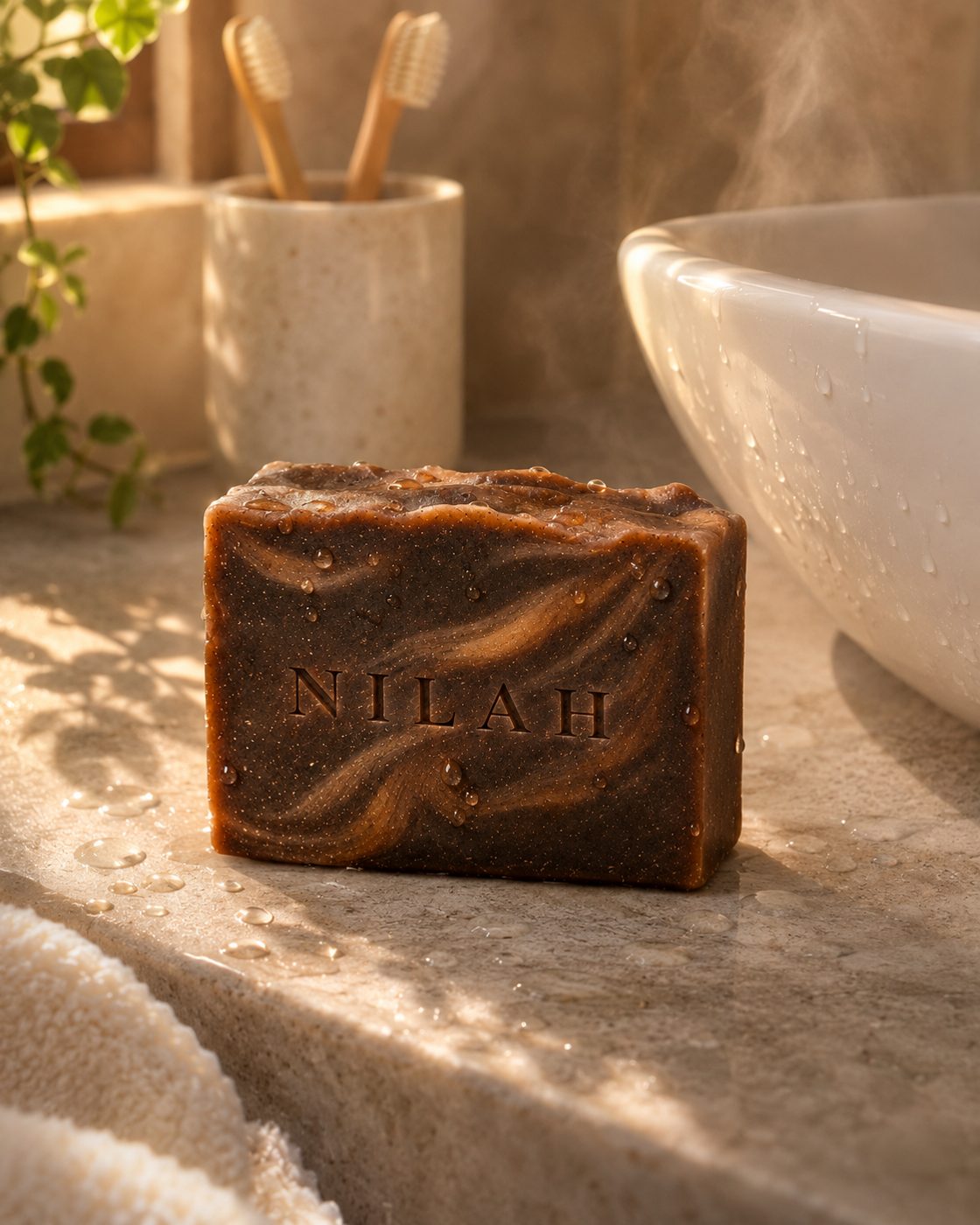
Handmade in Ethiopia, where the seed grows, an ancestral Ethiopian craft. Certified organic, cold-pressed Ethiopian black seed oil. A full 120g bar, naturally brown, made by the traditional Ethiopian method. Sold in one place, with nothing attached to it.
Get Nilah: current bundle pricingOnly at nilahskin.com · no auto-enrollment, ever100% money back within 30 days. Use it for thirty days, through two full cycles. If the skin in your folds does not feel calmer, softer and fresher, email us and we send your money back. You do not have to return the bars and you do not have to explain yourself.
This is an advertisement for Nilah, published by the brand. It is not a news article, a consumer protection notice or an independent review. “Hanan Yusuf” is a brand persona used for our customer correspondence, not a licensed medical professional, and nothing here is medical advice. The account given is illustrative of why the product exists.
ABOUT THE CLAIMSNilah's black seed oil content, organic status and Ethiopian origin are stated on the basis of our supplier's certificates. Nilah is handmade in Ethiopia, and the country of origin is printed on every box. “Traditional Ethiopian method” refers to how the black seed oil is pressed and to the artisanal, ancestral know-how with which the bar is made by hand. The descriptions of competing products refer to the general category of low-cost black-seed-labeled soaps sold online and are drawn from publicly posted customer reviews of those listings; no specific brand is identified and none is accused of counterfeiting Nilah. Photographs illustrating the checks are illustrative. Product specifications and prices were accurate at the time of writing and may change.
These statements have not been evaluated by the Food and Drug Administration. This product is not intended to diagnose, treat, cure or prevent any disease. Individual results vary and are not guaranteed. If you have painful lumps that keep coming back, lumps that drain, broken skin, or a sudden change in body odor, speak to a qualified healthcare professional: these can have causes no soap will reach. Do not use on open or broken skin, and try it on your inner elbow first.